Binding to H5 HA
Effects of tufted duck MHC-II mutations on binding to H5 HA
Pseudovirus deep mutational scanning of how mutations to tufted duck MHC-II affects its interaction with H5 HA
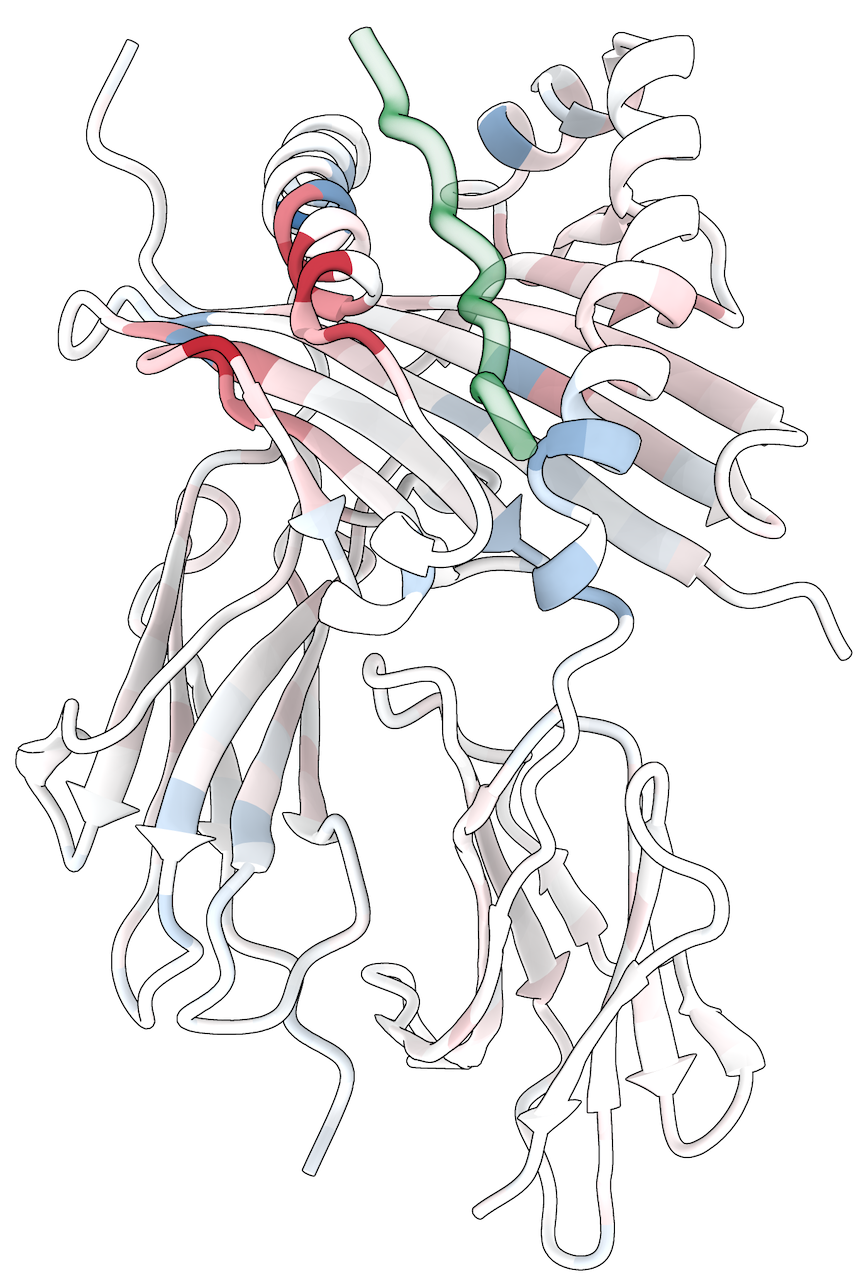
This website provides interactive visualizations and links to numerical data from pseudovirus deep mutational scanning measuring how mutations to a tufted duck MHC-II affect its interaction with H5 HA. The tufted duck MHC-II used in these experiments has Genbank accession numbers XP_032061117.1 and XP_032061025.1 for alpha and beta chains, respectively. The H5 HA used in these experiments comes from A/American Wigeon/South Carolina/USDA-000345-001/2021 (H5N1) strain.
For details about the study, see Dadonaite et al. (2026).
Visualizations and data can be accessed by clicking the gray boxes above for each measurement, namely:
For numerical values of the effects of tufted duck MHC-II mutations on interaction with HA, see this CSV.
For the full computer code and all numerical data files, see the GitHub repository. For full documentation of the computational pipeline, see the Appendix.
Note that these measurements are made using inverted pseudotyping of lentiviral particles, as described in Dadonaite et al. (2026).
The [numerical results]((https://github.com/dms-vep/Tufted-duck-MHCII-DMS/blob/master/results/summaries/HA_binding.csv) therefore include both the effects of MHC-II mutations on H5 HA binding (what you are likely interested in) as well as on inverted pseudovirus entry (this is a proxy for MHC-II folding, with mutations have negative cell entry effects if they greatly decrease cell entry).
The tufted duck MHC-II protein sequence used in these experiments (Genbank accession numbers XP_032061117.1 and XP_032061025.1 for alpha and beta chains, respectively) is here, and involves the alpha and beta chains connected by a 2A linker. The numbering used here is 1, 2, ... numbering of the ectodomains (see here for how that numbering scheme relates to sequential numbering of the 2A-linked protein; note that this is not the same as the standard numbering scheme used for human MHC-II proteins.
These experiments use lentiviral particles that inverse pseudotyped with MHC-II. These lentiviral particles encode no viral proteins, and therefore are not pathogens capable of causing disease.
See the biosafety statement in Dadonaite et al. (2026) for more details.